Discretionary cockpit, not autonomous trader.
Scanner surfaces; operator decides; orders go through the operator's own broker.
A discretionary cockpit for active trading workflow. Combines rules-based filters, memory-aware ranking, and an optional AI critic into one decision-support view.
Before
A watchlist that grew to 200 tickers with no honest ranking — equal visual weight for setups that deserved completely different levels of attention.
Decision fatigue mid-session — "should I take this?" answered 50 times a day, drifting toward action because action felt like progress.
Sector performance, regime, and breadth lived in three different browser tabs. The macro picture rarely informed individual ticker decisions in real time.
Upcoming IPOs and corporate events got missed because the daily scan didn't cover them — discovered late, often after the move.
No honest record of "close calls" — the times the scanner said wait and the operator wanted to take it anyway. The hardest lessons were the least visible.
What we built
TT Scanner is the discretionary trader's daily workspace. It runs only during U.S. market hours — automatically wakes itself a few minutes before the open and scales to zero overnight, on weekends, and on NYSE holidays. No idle infrastructure.
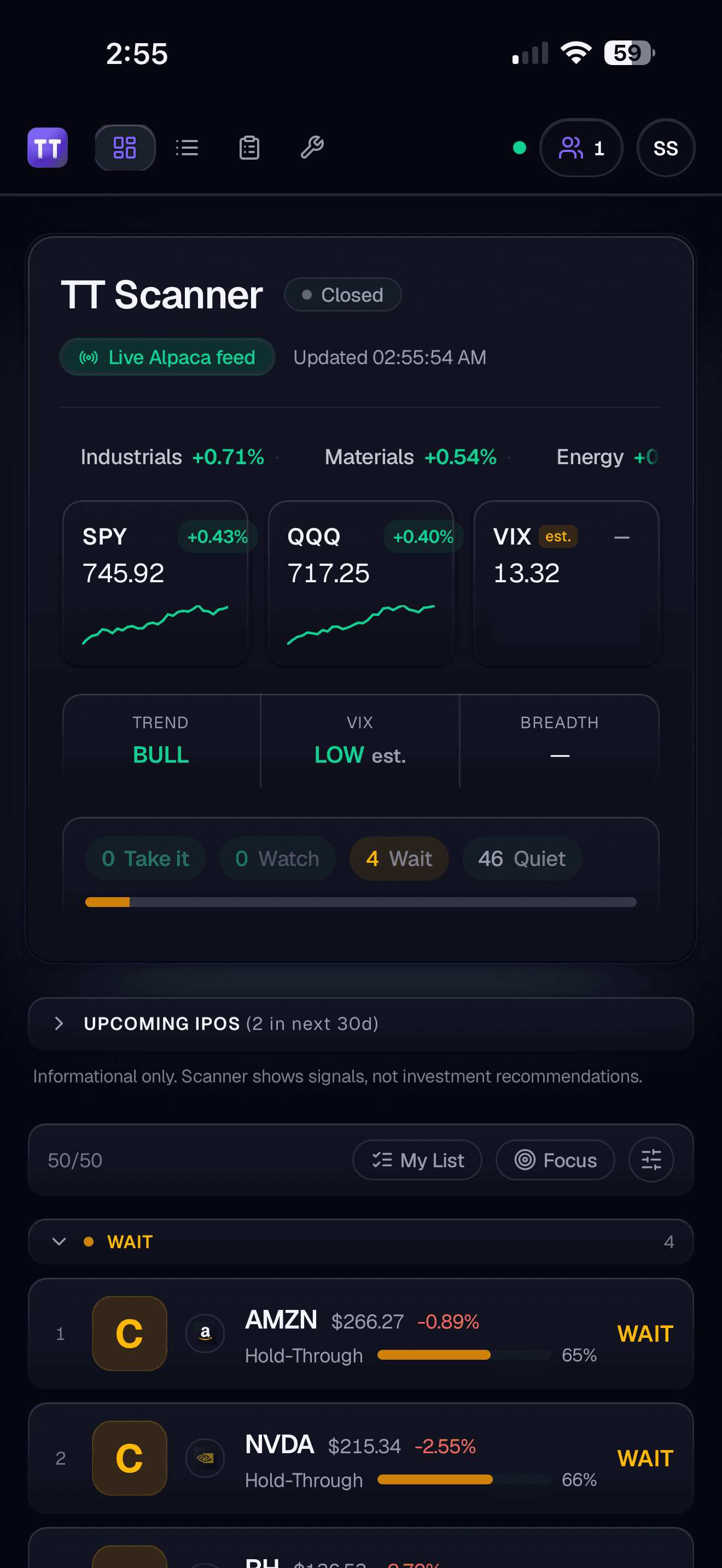
During the session, the scanner ingests live market data and produces a single ranked view. Tickers are bucketed into four categories: Take it, Watch, Wait, and Quiet. The macro frame — sector performance, regime classification, breadth signal, VIX — sits at the top of the same screen, so the context shapes every individual decision.
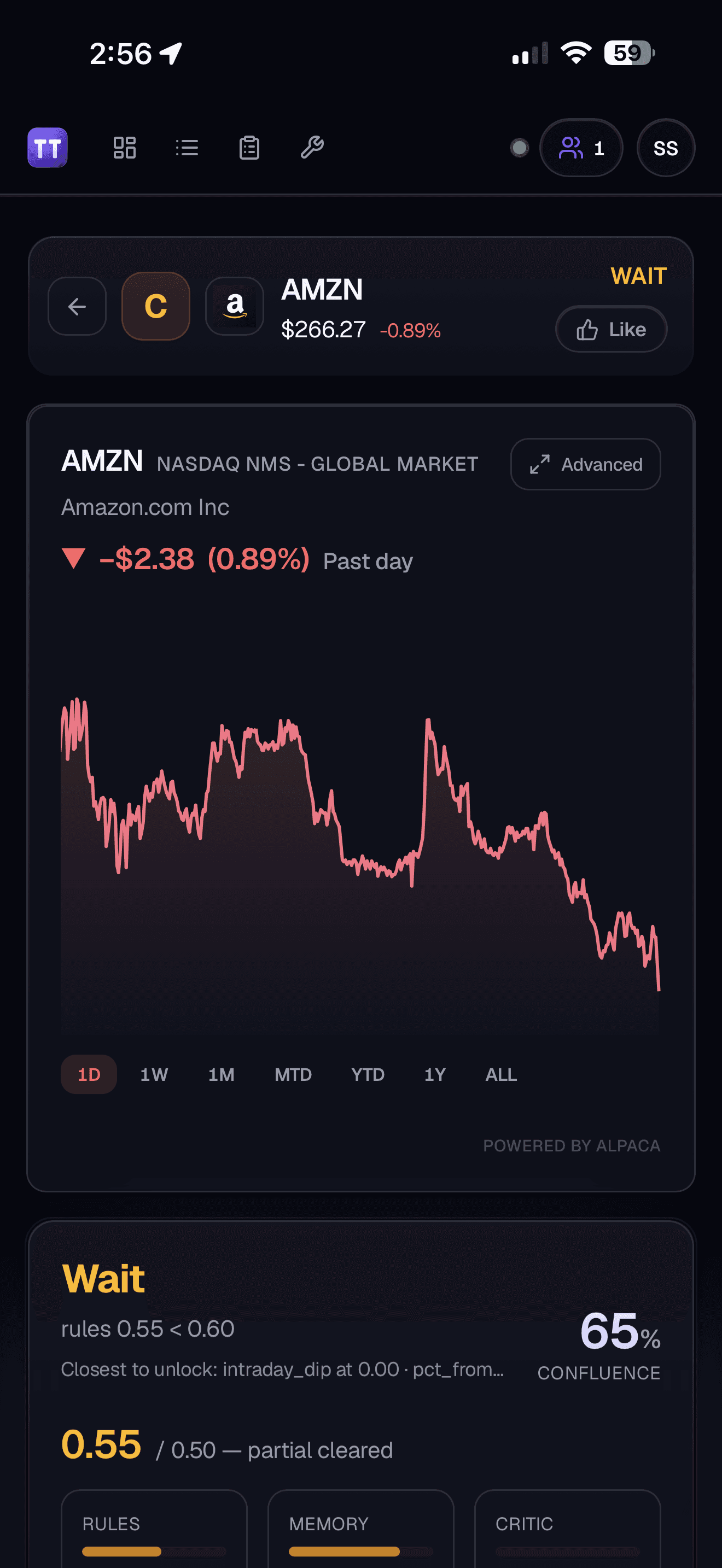
Each ticker opens to a detail card showing three independent signals: a rules-based score, a memory-aware match against historical setups, and an optional AI critic that fires only when confluence warrants the cost. A "closest to unlock" explanation tells the operator why the answer is wait, so they can hold without second-guessing.
The scanner places no orders. Every position the operator takes goes through their own broker on their own platform. The cockpit's job is to surface signal and suppress noise — the decision and the execution stay with the human.
After
The 200-ticker watchlist self-organises every minute. Take it / Watch / Wait / Quiet replaces "scroll the list looking for something interesting."
Macro context is glanceable. Sector + regime + breadth sit above the tickers — the answer to "is this setup with or against the day?" is one look away.
The Wait bucket is honest about its reasoning. "Rules 0.55 of 0.60 — closest to unlock: intraday dip" reads as a specific not-yet, not a vague no.
Decision fatigue dropped sharply. The cockpit absorbs the ranking work; the operator's attention concentrates on the 5–10 tickers actually worth a decision.
Cost stays near zero on quiet days. Cron wakes the scanner only during market hours; scale-to-zero handles the rest.
Every classification is auditable end-of-day — the operator sees what the cockpit thought, what they did, and where the two diverged.
Audit stack
Scanner surfaces; operator decides; orders go through the operator's own broker.
Cheap, deterministic, auditable. Memory + AI layers fire only on confluence.
Today's pattern compared to its closest historical neighbors, with win rate.
Fires only when rules+memory disagree; every invocation persisted to the trail.
Cron wakes the scanner before open; no idle infrastructure overnight or weekends.
Proof
A live look at how TT Scanner presents the trading day — from macro context down to the per-ticker decision card. Every screen is designed to make the right call feel obvious.

Next
If your trading day looks like noise-management and decision fatigue, we can build the cockpit that gets the noise out of the way. Book a free intake to scope it.